by Justin Query
EDITOR’S NOTE: This essay is published from an original source, reprinted here in anticipation of Ti West’s latest film Maxxxine, which allegedly brings the trilogy to a close.
***
It’s Halloween season once more, and soon neighborhoods will be flooded with children and adults hiding their faces behind masks, thereby reinventing themselves for a single evening, all in service of a good scare, of a moment of transformation. On this spirited evening, tradition dictates that people will inadvertently encounter vengeful spirits over the course of the night – so disguising behind a mask would fool the ghoul into seeing living people as one of their own. If only it were so easy to hide oneself.
In Ti West’s latest film Pearl (2022) – the unexpected and violent prequel to his successful slasher film X (2022) – the director and his fellow filmmakers utilize the metaphor of masks as more than a means to protect yourself while trick or treating. Employed both literally and figuratively, the masks in West’s visceral motion picture explore the extent to which one will construct an identity for themselves in order to fool themselves or those closest to them.
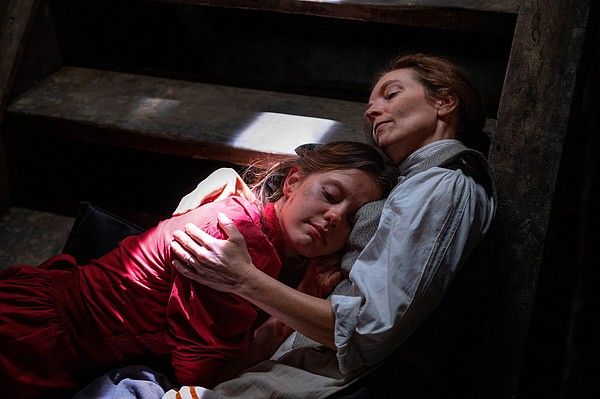
Perhaps the best spooky season surprise regarding Pearl came in February of 2022 when West not only screened his then-latest horror film X at SXSW but also teased that he and star Mia Goth had already collaborated on and completed a prequel origin story for the slasher film’s titular antagonist. All of this was done in relevant secret during lockdown, which remains an important detail not only of the film’s production but also of the context of Pearl and its plot. Specifically, X takes place in 1979, a year after John Carpenter’s Halloween (1978) hit the big screen … a year before Friday the 13th (1980) would further reinvent the genre game … and on the precipice of the slasher film subgenre’s popularity in the film industry. The film is the story of a handful of independent adult filmmakers (Mia Goth, Kid Cudi, and others) who settle upon a secluded farm in order to make a stag film, but once there, they’re besieged by the erratic matriarch of the property (also Goth) for what appears to be their lascivious, sinful behavior. Pearl, meanwhile, takes place about 60 years earlier – on the same farm – quietly populated by Pearl (still Mia Goth) and her devout, repressive mother Ruth (Tandi Wright). They struggle to survive during the 1918 Spanish flu epidemic, while Pearl also fights to suppress the dark impulses that have been rumbling inside her. When the audience first meets Pearl, she dances elegantly and narrates to the animals housed in the family barn how she is destined to escape the family farm and become a star despite the fact that her mother insists that her daydreams will lead nowhere. But her fairytale-like daydream takes a dark detour when, without warning, Pearl summarily stabs a goose with a pitchfork and feeds its carcass to the alligator that lives in the nearby pond.
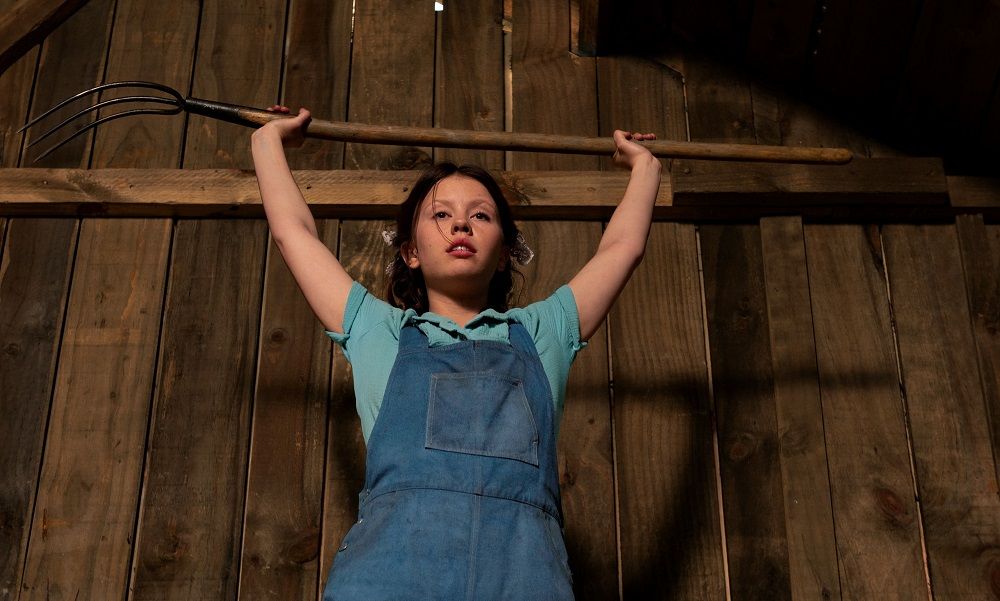
As the audience, we’re at first entranced with young Pearl’s predicament. Who hasn’t stared at the horizon and imagined something more? Few, though, temper those dreams of success with the indiscriminate slaughter of a barnyard animal to satiate the local wildlife.
Immediately, the audience is introduced to the duality of good and evil that West’s film explores. It’s a serendipitous move that West was afforded the good fortune to produce X in the middle of the world’s lockdown – a horror movie shot within the restrictions of a horrific reality. It was a stroke of creative genius, then, that West also exploited the pandemic masks by setting his prequel during the spread of the Spanish flu in America that took so many lives and required the use of masks as well. In this way, Pearl operates as meta-horror, running several layers deep, fully reflecting West’s thesis that no mask can keep one safe from exposure, whether physical or symbolic.
Growing up on the farm, Pearl always envisioned herself as a unique, special, and beautiful girl surrounded by the mendacity that the farm nourishes – shared by her conservative mother Ruth and her father (Matthew Sunderland) in failing health at the hands of influenza. Pearl sees herself much like the caged canary imprisoned in the family’s living room, singing wildly and performatively with nowhere to go. She imagines a fate for herself that includes dancing in the Follies on the big screen. Secretly, Pearl seizes upon the opportunity to see a motion picture in town when charged with getting the medication that will treat her ailing father, and as Pearl prepares to ride her bike to town that day, Ruth reminds her to wear her mask in the company of others. But when Pearl arrives in town, she remains one of the only people unmasked, a foreshadowing of the significance of the masks, not just as protection against the flu but as a means of disguising one’s true nature.
At home, Pearl wears a symbolic mask, hiding her dark urges from her family, killing water fowls, crushing alligator shells in the secrecy of the barn. Once out in the world and away from the farm, however, she is by and large free to express her true desire for a life in show business. The twist, revealed much later in the film, is that Ruth is completely aware of Pearl’s suppressed violent urges. When she asks Pearl to wear a mask so as to not bring illness back to the farm, she’s ultimately asking Pearl to hide those uncomfortable aspects of herself to the world so that no one ventures to the farm to investigate the family that lives there. As German immigrants living in America during WWI, Pearl’s family fears how the world will respond to them. Like the influenza itself, the community’s awareness of the family’s heritage threatens to destroy the entire homestead. It is precisely when Ruth reveals to Pearl that her attempts to mask her urges were fruitless that an exposed Pearl violently responds to her mother, setting Pearl on the dark path that culminates in X.
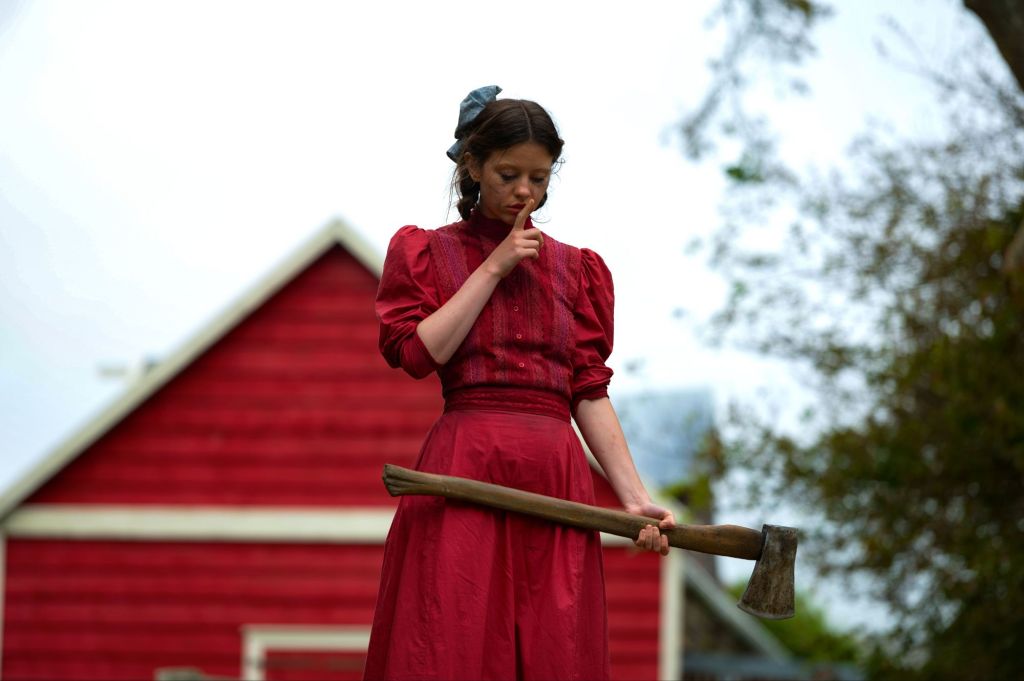
Additionally, the local theater protectionist (David Corenswet), who is never credited with a name and is thereby masked in anonymity, further elevates the role of identity in the film. His entire existence is defined simply by the potential gateway to a career in film that he can provide for Pearl. His identity is represented through the empty promises that he might one day whisk Pearl off to Europe, far from the farm that she hopes to escape. But even the protectionist symbolically intones to Pearl at one stage in the film, “It’s hard to recognize anyone with all of these masks.” It appears that most people attempt to disguise their true nature in the world, and West underlines this theme by staging Pearl during the 1918 Spanish influenza. But just as Pearl hides her true self from the protectionist so that her true self will not interfere with the dreams she has, once Pearl glimpses the protectionist’s hesitation in making her dream come true, he is irrevocably unmasked to her, and she feels that she has no choice but to kill him. She was seduced by the dream of Hollywood stardom, but once awakened from that dream, Pearl becomes the nightmare.
If deception is an act of performance, and a performance was what the young Pearl longed for all along in order to recognize her dreams, then perhaps Ti West’s latest film demonstrates that the greatest horror was always lurking behind the mask, in the recesses of roleplaying that we never imagined could kill us all.
Pearl is currently streaming on Amazon Prime.
***
Published from an original source by Justin Howard Query.
 Front Center Seat [Is Where I Sit]
Leave a comment