
by Justin Query
***
The spooky season is fully upon us, and so many are preparing their creepiest costumes for a night’s long quest for candy, outfitting their homes to frighten even their bravest friends and neighbors. And if the search for Snickers candy bars or the hunt for haunted houses is any indication, then Halloween has so much to do with venturing into new territory, outside of one’s comfort zone.
And few horror films accomplished that goal more than The Old Dark House, produced by Carl Laemmle and directed by James Whale. Turning 92 years old this month and turning the classic expectations of the haunted house thriller into something framed quite a bit differently than before, The Old Dark House demands a visit from you like never before.
***

At first glance, 1932’s The Old Dark House shouldn’t work as a horror movie. Coming from Universal Pictures, it doesn’t subscribe to the conventions that would make the movie house’s monsters – Dracula, the Wolf Man, the Mummy, and more – household names. Produced by Carl Laemmle, directed by James Whale, and starring Boris Karloff, the movie lacks the terror of Frankenstein (1931). Even by today’s standards, the film doesn’t do anything innovative, where horror is concerned. Moviegoers are familiar with the narrative of travelers who find themselves in the wrong place at the wrong time, a trope made popular in Psycho (1960), The Texas Chain Saw Massacre (1974), House of 1,000 Corpses (2003), Wrong Turn (2021), and more. But one should consider that what these films do within the genre wouldn’t gain popularity until the 1960s, 1970s, and 1980s, and after — decades after The Old Dark House was produced. Even the film’s title suggests that viewers will see a Gothic haunted house movie, and – in a way – viewers did. But the film’s house isn’t haunted by ghouls and long-dead things that go bump in the night. In fact, the house is plagued by the people who live there, providing viewers with a unique approach to horror movie expectations.
The film is the story of five travelers who seek shelter from a devastating storm by taking sanctuary in a foreboding, uninviting mansion. But once safe inside the house from the storm, the travelers (Melvyn Douglas, Charles Laughton, and others) find themselves psychologically and physically threatened by the eccentric family that lives there. From the moment we enter the old dark house, we understand that we’ve ventured into precarious territory. Invited into the home by Morgan the butler (a disfigured Boris Karloff who spends the first half of the film mumbling indecipherably and lumbering about), we meet the brother and sister hosts Horace Femm (Ernest Thesinger) and Rebecca Femm (Eva Moore), who make it perfectly clear that they’ve been inconvenienced by this unannounced visit.
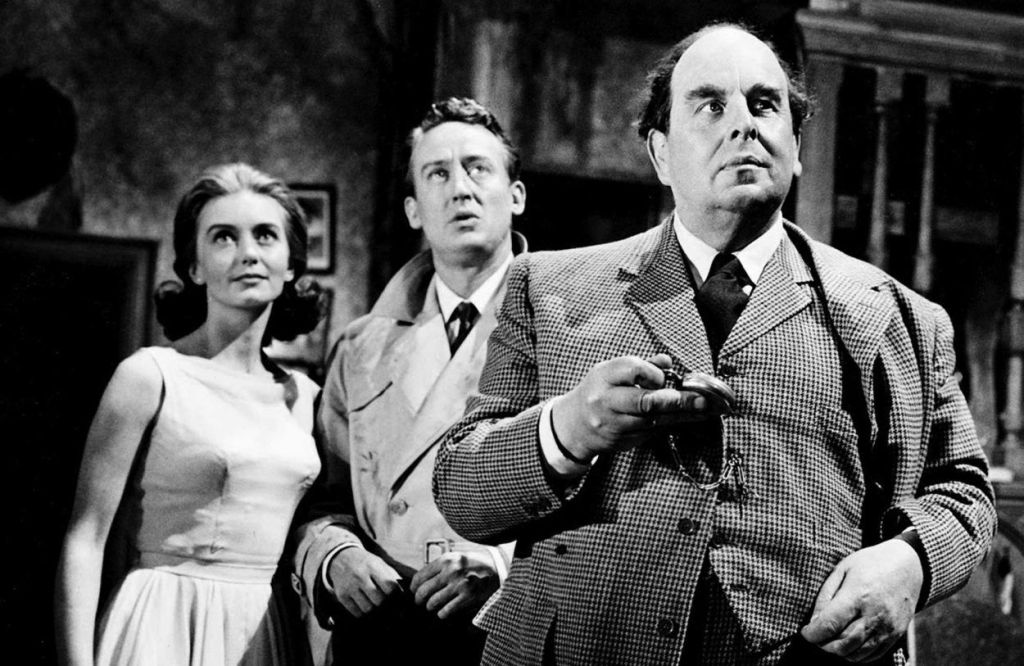
They are absolutely incapable of comforting our unfortunate travelers, denying them beds upon which to sleep and even room by which to store their belongings. They not only give shape to an uncomfortably public display of sibling rivalry but the worst parts of aristocracy from which they come. They represent a rather archetypal representation of blue bloods, their roles highlighted by the particulars of their characters. Horace remains perpetually emasculated by his sister, and Rebecca’s near deafness assures that she will never fully be able to communicate with nor ultimately understand anyone on any level but her own. Here, they immediately illustrate a madness brought on by the very isolation that they crave, and that madness will infect our would-be heroes as long as they stay in the house.
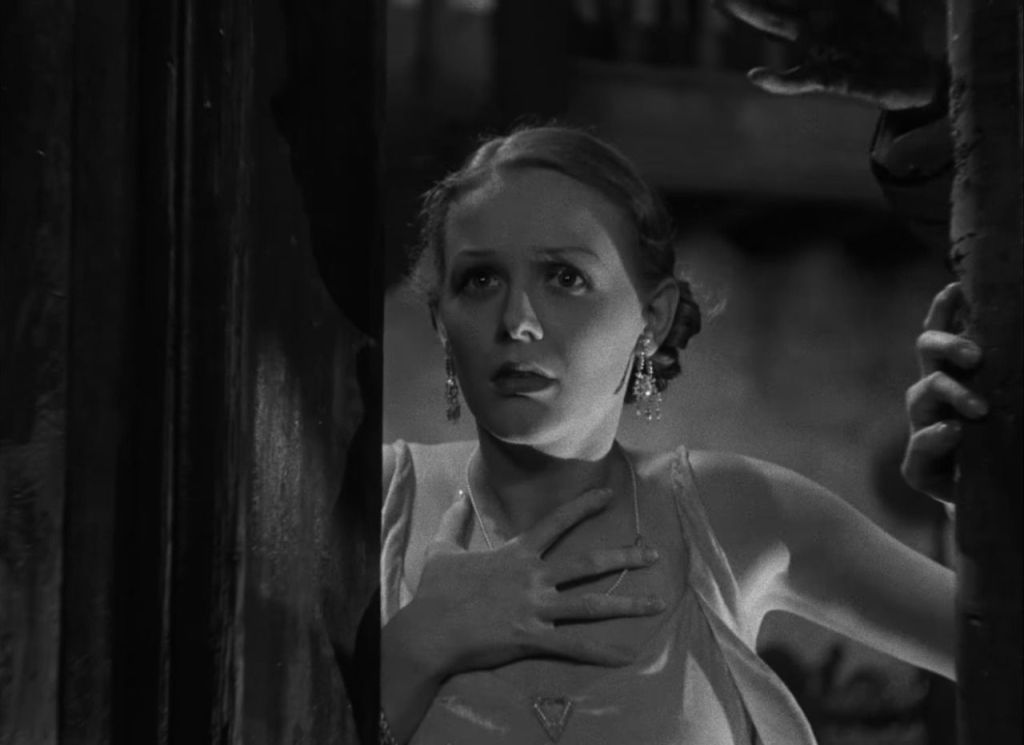
But this isn’t to suggest that Rebecca – even in her deafness – is not a threat to her new guests. Alone in a bedroom with Margaret (Gloria Stuart), Rebecca pulls out all the psychological stops as she tells the story of her beautiful, “sinful” sister, who died at the age of 20, insinuating that her sister’s beauty and sexuality are precisely what made her punishable by death, further insinuating that Margaret will meet the same fate. Now left alone in the room, Margaret is overwhelmed with the echoes of Rebecca’s speech, imagining Rebecca’s distorted face in the mirror, thereby reflecting Margaret’s own distorted understanding of herself. But she isn’t haunted here by a disembodied spirit or ghost but the oppressive thought that her own vitality will contribute to an untimely death, yet another manner in which the house will haunt its guests.
The slow in movement and apparently slow in thought Morgan is called “dumb” early in the film, but he too is not to be underestimated. We’re meant to be discomfited by his appearance yet assured that he is harmless to the guests, at least at first. But once Morgan’s violent alcoholism is revealed, the guests are now threatened by a new form of specter. It’s a threat explored by Stanley Kubrick in The Shining (1980) and given metaphorical shape in Bryan Bertino’s 2016 creature feature The Monster. But incensed to violence once intoxicated, Morgan’s role in the film does not mean that his appearance is representative of the danger that he posed to our protagonists from the moment they entered the old dark house. Rather, he symbolizes the dangerous – even pitiable – effects of addiction, simply one more monster that victimizes those nearby, including our five travelers.
But the film’s house isn’t haunted by ghouls and long-dead things that go bump in the night. In fact, the house is plagued by the people who live there, providing viewers with a unique approach to horror movie expectations.
Yet some threats in the house are far more immediate, even if the family’s efforts to keep it hidden in the recesses of the house will prove fruitless. Saul (Brember Wills) has been locked away in a corner of the home in order to keep him from bringing harm to the mansion. But once Saul is released by Morgan, we learn of Saul’s fascination with the origins of his name – a Biblical king who was neither a very good king nor a very good person. Now, fascinated with fire, our Saul hopes to raze the mansion to the ground in what he considers a burnt offering, even if it means destroying the house with innocents inside it. Whatever notions Saul has taken from the derivation of his name have turned into zealotry, and his madness becomes the most incarnate in the film, capable of killing anyone unfortunate enough to take refuge against the natural danger of a storm only to succumb to the much more physical dangers that the old dark house has protected for so long.
There’s a dark humor that critics celebrate when referring to The Old Dark House, and that ingredient should not be ignored. But what should also not be ignored is the contribution that this film made to the genre, deviating from the anticipation of traditional haunted house films and creating one of the most recognizable tropes, that of a fish in danger, out of water – or a thunderous rain storm. It would become a cinematic threat made ridiculously popular in decades to come.
Perhaps that’s why there’s truly no place like home today.
The Old Dark House is currently streaming on Amazon Prime and other streaming services.
***
This piece — written by Justin Howard Query and after some editing here — was originally published by another source.
 Front Center Seat [Is Where I Sit]
Leave a comment