by Justin Query
***
Celebrating an anniversary greater than more than 20 years, Barry Levinson’s Bandits (2001) does what Barry Levinson’s films do best.
His films trick you into thinking you’re simply watching a film about a quiz show scandal or simply watching a film about an edgy radio DJ in Vietnam or simply watching a film about two estranged brothers on a road trip of self-discovery. But when you watch a Levinson picture, you’re watching something a bit more nuanced and careful — just as you do when you watch Bandits, a film not so much about two dysfunctional bank robbers as about the allure of myth and storytelling and how we all somehow perpetuate the narrative.
***

The folk song that introduces the audience to director Barry Levinson’s 2001 film Bandits — Bob Dylan’s “All the Tired Horses” — is cleverly simple in its repetitive song structure. To be certain, the song is the seemingly perfect opener for a bank heist movie, a film genre that is as recognizable — repetitive even — in its execution as the anticipation that the audience feels as they watch the scripted story of the likable underdog Robin Hoods thwarting the comically inept law enforcement agents who never really stood a chance.
Repetitive.
We’ve seen this story before.
But this is where the audience has been fooled again, like a bank security guard who mistakes the tip of a neon highlighter for the muzzle of a loaded handgun shoved into the base of his neck.
Similarly, the audience has been taken hostage by Levinson and the other moviemakers behind this disarmingly underestimated film that, even 20 years later, remains deliberately astute in its structure and purpose.
What audiences thought they were seeing — a run of the mill bank heist film — was much more than they originally imagined: a film that perhaps looked like a narrative told so many times over but in actuality played out as a story of the complexity of relationships, of the power of mass media, of the elusive nature of storytelling.
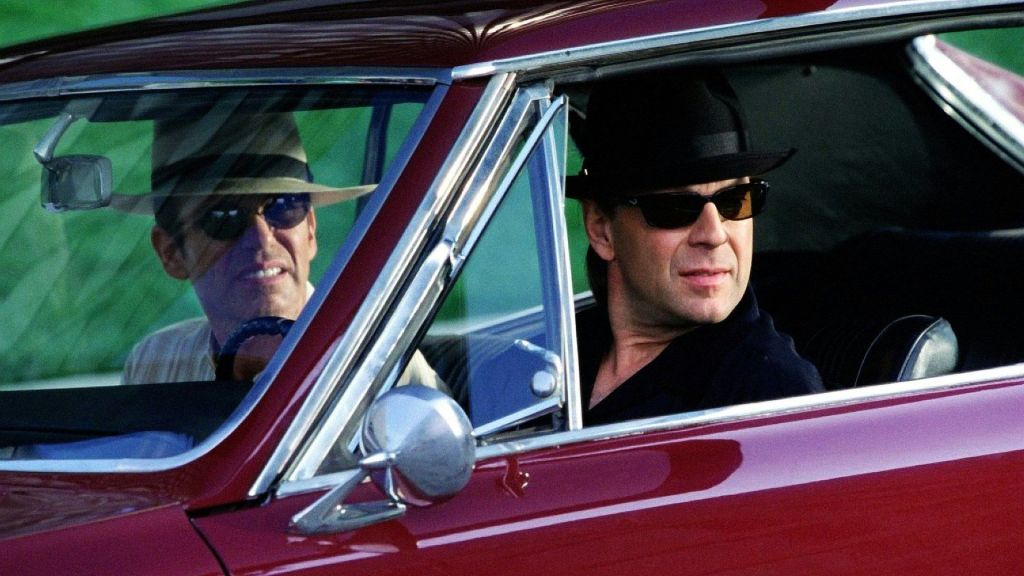
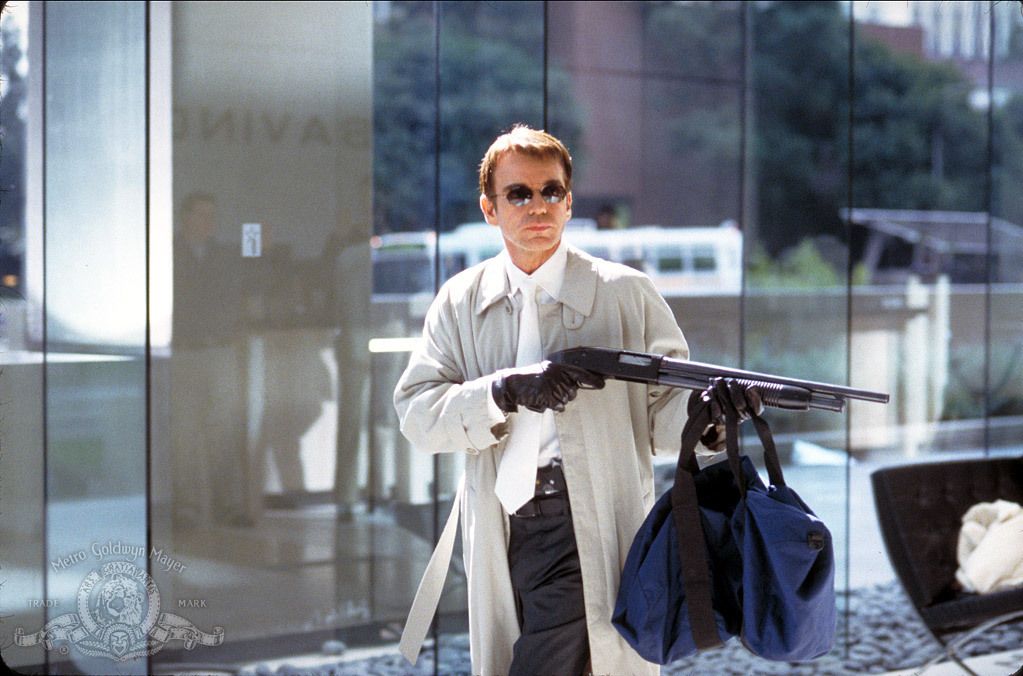
Bandits follows the criminal footsteps of Joe Blake (Bruce Willis) and Terry Collins (Billy Bob Thornton), two inmates who escape from prison and hope to own their own tropical island resort. Financing their dream, however, will require some ingenuity. The solution is to rob a few banks along the way, but it’s more complicated than that. They’ll kidnap a targeted bank manager tonight; spend a uniquely restful — albeit awkward — evening at home with the family; and then burgle the bank first thing tomorrow morning.
The media will come to call them the “Sleepover Bandits.”
The Sleepover Bandits will become both a literal and a metaphorical overnight success.
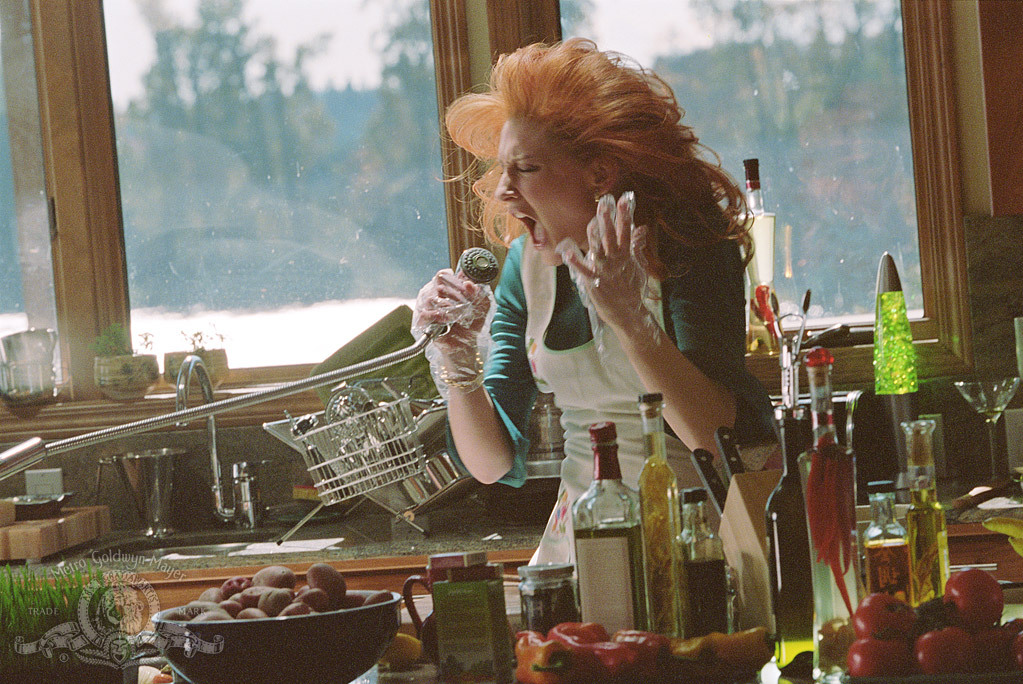
Things get more complicated, though, when estranged housewife Kate Wheeler (Cate Blanchett) — desperate for attention and desperate for meaning in her own life — appears to take the two thieves’ brilliant scheme hostage herself when she stumbles across the two and threatens to expose them to authorities lest they allow her to become an accomplice to their plan. Along the way, Kate falls first for Joe — the adrenaline-fueled straight-shooting man’s man. She then also falls for Terry — the sensitively neurotic intellectual with a medicine cabinet filled with medications and phobias. Alone, the two couldn’t be more dissimilar. But together, they’re the perfect man for Kate. Once the two begin fighting for Kate’s hand, the heist schemes and romantic dreams quickly begin to fall apart, until Joe and Terry devise one last job that will ensure their intended paradise. To pull it off, they’ll need to put their differences aside. They’ll also need a little bit of media, a little bit of theater, a little bit of storytelling.
And that’s where the story of Bandits begins. When most bank heists begin before the safe has been cracked, before the crime has been committed, Levinson’s narrative begins at the end, so that the audience knows that these particular criminals won’t survive this particular heist.
The end is near.
In fact, the end is where we begin.
Because their final heist — as reported by the nationally-televised true crime TV program Criminals at Large host Darren Head (Bobby Slayton) — will end in the deaths of both bandits. The reveal is no spoiler: it’s pure theater that’s established within the first five minutes of the film. Yet 24 hours before the bloody shootout that took their lives, the two had also hijacked the sensationalist crime program in order to tell their story — the true story — and herein lies the magical power of story that Levinson establishes throughout the narrative.
Joe and Terry’s celebrity and fame is framed early through the use of other sensational stories with which the audience is familiar, setting the mythological tone that the movie will come to respect. “It’s part Bonnie and Clyde … it’s part Barnum and Bailey,” Head intones, and these allusions are intended to provide a real-world context for the duo. The audience immediately understands them without a need for much exposition. Yet even though the host promises the “true story” — the inside story, so to speak — it should be clearly noted that the storytelling itself isn’t authentic but artificial: video can be paused, edited, and even stopped. Life doesn’t work that way, but that’s specifically the message that Levinson intends to send (and there’s Levinson himself, if you glimpsed him, sitting at the show’s control board).
But life can work that way here.
In a similar fashion, Levinson peppers the film with momentary flourishes that reinforce the film’s fascination with the importance of, need for, and purpose for storytelling. Joe and Terry’s first hostages are a couple of hypersexual teens who have both manufactured narratives so that their parents won’t know what they’re up to that weekend. Neither one of them has shared with their parents the truth of what “no good” they’re up to this weekend, and therein bakes that motif of storytelling into the recipe. Later, the teens’ harmless recollection of the bandits’ kidnapping will be distorted to suggest that they were in persistent peril when they ultimately had nothing to fear in the first place. That, too, remains false and simply perpetuates the film’s exploration of what people think they understand based upon the information that’s been provided to them.
During one particular bank robbery, a pair of officers roll their cruiser up to the bank’s drive-up window, eager to flirt with the daily teller who works there. Terry, though, in disguise, must think quickly in order to explain her unexpected absence. “Where’s Dottie?” the officer asks. Terry — a hyperactive bevvy of medical knowledge due to his own uncontrollable hypochondria — awkwardly invents an equally awkward explanation after a beat of silence: “She’s sick … With vaginitis. She’s been suffering from an abnormal vaginal discharge. It’s a common symptom — viscous fluid that’s usually associated with — well — vaginitis.”
Exit the police.
Now, back to our story.
And during one intense getaway, the bandits are captured on film by a cinematographer filming a music video alongside the highway, and the footage is later utilized by the media to highlight the danger that Kate Wheeler is in as a hostage of the bandits. On the contrary, Kate Wheeler is no victim in this crime spree. She is, in fact, a willful participant. She is in no danger, he’s in love — doubly so. Bank managers and bank tellers across the nation come to welcome Joe and Terry into their homes and into their places of business because the bandits — even holding them at gunpoint — are notorious for never resorting to violence. Try as it might, the media paints the Sleepover Bandits as villains, going so far on the TV program Criminals at Large to call the seemingly innocuous thieves “the most successful bank robbers in the history of the United States.”
But the “true story” is decidedly different.
The Sleepover Bandits are more folk heroes than Mickey & Mallory of Oliver Stone’s Natural Born Killers. If a story is something that can be truthfully told, a story is also something that can be manipulated, whether purposely or accidentally. Narrative itself is simply a matter of perspective, sometimes controlled by others, sometimes controlled by yourself.
And securing their story is as important to Joe and Terry as securing their dream. They’ve lived a primarily anonymous life, reduced to obscurity by the prison inmate numbers that have come to define them. And through their tropical island paradise, they can rise above that mediocrity, thereby flipping the script. Unfortunately, sometimes the plans we’ve constructed for ourselves are upset by other forces. When Kate interrupts their scheme, the narrative itself is absolutely transformed. Even Kate’s hopes of living a happy home life with a loving husband were destroyed. On the evening that she ultimately leaves that life behind, Kate has prepared a rather remarkable meal for her husband. When he tells her that he won’t be dining with her after all, he absently suggests that Kate should “see a movie,” in and of itself a contrived mode of storytelling meant to distract her from the depressing real-world story playing out before her eyes.
What audiences thought they were seeing — a run of the mill bank heist film — was much more than they originally imagined: a film that perhaps looked like a narrative told so many times over but in actuality played out as a story of the complexity of relationships, of the power of mass media, of the elusive nature of storytelling.

The unlikely romance itself becomes a figurative — if not comical, heartwarming, and even oddly believable — demonstration of the potency of narrative. For too long, Kate has had a story in her heart of what love should be, perhaps fueled by what she’s read in fairy tales, perhaps manufactured by what she’s seen on the silver screen — just as all people imagine how it’s going to be — and that narrative is betrayed. Now, she begins to understand that a single narrative — like love — can have multiple stories. She fell in love at first with Joe’s rugged strength and muscled embrace. It could have been happily ever after. But then she also fell in love with Terry’s vulnerable sentimentality and particularly affectionate attention. And just like a narrative can be seen from multiple perspectives, so too can a story take many different divergent directions. “What if I don’t want to choose?” Kate asks them both as their love triangle threatens to fragment. And in the end, Kate does, in fact, make a decision: to remain with them both, in a happily ever after that few storytellers could have constructed.
In getting there, that final heist becomes the bandits’ greatest feat in storytelling and a fitting conclusion to Levinson’s vision: a bank heist movie that audiences anticipated they had already seen. They’d seen this story so many times before. But here — in the hands of a master filmmaker — Bandits becomes something wholly different, a contrived story the likes of which no moviegoer saw coming.
Having shared their story already with the media, Joe and Terry control the narrative itself. And they won’t stop in holding the audience’s attention there. Their bloody deaths, it would appear, are also controlled, also the stuff of narrative: a spectacle made real through the use of special effects, stunts, blood packs, and trickery, so that that tropical paradise conclusion becomes the reality that all three bandits had envisioned.

If a story is something that can be truthfully told, a story is also something that can be manipulated, whether purposely or accidentally. Narrative itself is simply a matter of perspective, sometimes controlled by others, sometimes controlled by yourself.
Because good storytelling has relied on stranger, more uncommon ingredients, after all, and therein lies the deceptive brilliance of Levinson’s film — of almost any Levinson film. When audiences saw Good Morning Vietnam in 1988, they weren’t simply seeing a comedy about a left-of-center radio DJ but a film that underscored the complex difficulties of war — Vietnam, in particular — and how levity can uplift even the most hopeless of human endeavors. When audiences saw The Bay in 2012, they weren’t simply seeing a found footage eco horror film about mutated aquatic life but a film that highlighted the very real ecological catastrophes for which the world can and will be responsible.
So too does Bandits rob the viewers of their initial expectation that they were going to see a run of the mill bank heist movie, the likes of which have charged through movie theaters for decades with tremendous box office success. With Bandits, Levinson penetrated the vault of the traditionally underestimated caper film and elevated it into a meditation on and discussion of not only the power of media but also the power of narrative and how it can shape and continue to reshape the world that once seemed so familiar to us.
That the film does so — masterfully so — simply speaks to Levinson’s ability to consistently usher audiences into a theater with the expectation of seeing one story unfold …
… And witness something altogether challenging play out before them.
The end.
Bandits is currently streaming on Amazon Prime, Hulu, Max, and other platforms.
***
This piece — written by Justin Howard Query and after some editing here — was originally published by another source.
 Front Center Seat [Is Where I Sit]
Leave a comment