by Justin Query
***
Celebrating its four-year anniversary on October 1st — utilizing the ingredients of horror movies — Brian Duffield’s Spontaneous remains an inventive genre film that says something truly smart about the young adult experience. Like Freaky (2020), It’s a Wonderful Knife (2023), and I Saw the TV Glow (2024) before it, Spontaneous asks some difficult questions about growing up.
And the answers — unfortunately — are fragile.
So handle with care.
***

One’s life is like a timebomb. One never knows how much fuse is left before the inevitable boom that will bring destruction, once and for all. It’s such a simple metaphor, then, that it’s altogether surprising that many people have difficulty understanding the nature of it, that many have difficulty accepting it as a part of life. Faced with adversity, some people suddenly behave as if death, destruction, desertion, and other daily dangers are something foreign to the world, something that should never befall them. People become more concerned with discovering the source of the tragedy rather than discovering how they’ll keep putting one foot in front of the other or how they’ll respond to that assured hardship. This paradox is both the question and the answer at the center of director Brian Duffield’s darkly comedic body horror film Spontaneous (co-written by Aaron Starmer), which explores a philosophical response to the difficult situations in which we all ultimately find ourselves.
The movie tells the story of Covington High School. It’s autumn, and this year’s graduating seniors impatiently await the opportunity to enjoy Homecoming, prom, and all the experiences that they’ll have for the last time before leaving high school forever. Unfortunately, some students will be leaving the building sooner than others, when random students begin spontaneously combusting, blowing up like car bombs at similarly random moments: at a kegger, at a sports event, in the middle of a Socratic seminar on Hamlet. It becomes an epidemic that cuts through the senior class with senseless explanation. From out of this frightening, blood-soaked swath, Mara (Katherine Langford) and Dylan (Charlie Plummer) forge a spontaneous romance as well, and they’ll be challenged in seeing if their love can survive it, if they too can physically survive in the process.
As the film begins, Spontaneous possesses many of the ingredients synonymous with a teenaged coming-of-age movie, and that’s part of the production’s charm. We open in the middle of a high school math class, and within the first 10 minutes, we’ll see characters breaking the fourth wall à la Ferris Bueller’s Day Off and directly addressing the audience with well-timed, sardonic wit, despite the shockingly graphic initial explosion of an otherwise anonymous classmate. But viewers are then led to ask what metaphorical significance the combustions may have.
These bodily bombs must serve another purpose than to simply wash everyone in the immediate area with blood, yes? Of course. Could the combustions represent the inevitable and symbolically painful transition from youthfulness to maturity? Could they be the result of teen behavior – perhaps caused by sex or drugs or alcohol, like a 1980s slasher villain exacting punishment upon the sinful behavior of teenagers? Is the town simply cursed in some supernatural way? This becomes a popular theory since the explosions are isolated to Covington alone, but the teens’ responses to the combustions come to the forefront of the film.
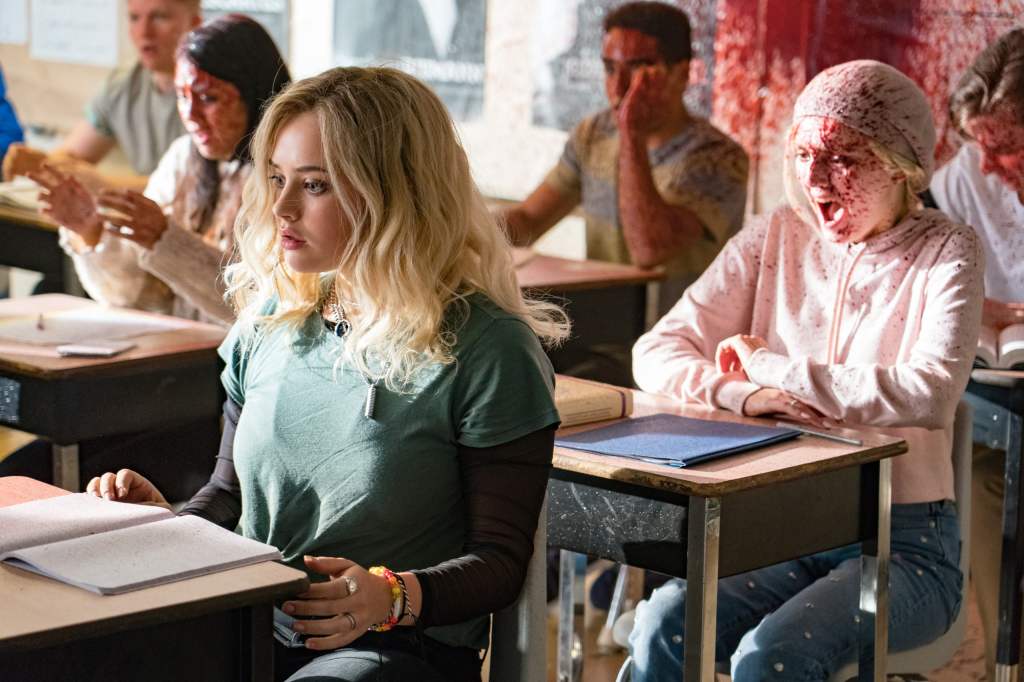
For his own part, Dylan’s brush with the possibility of death finally inspires him to profess his crush to Mara, which develops into a rather immediate romance. “Kaitlyn exploded in the middle of Pre-Calc and got me thinking about life, in an ironic way,” Dylan explains to her. “And what would happen if I popped, you know? And then you said: it might happen again. It made me think, ‘I’ve got to get shit done, in case she’s right.’” And as much as Mara & Dylan’s romance distracts them from the increasing body count in Covington – if spontaneous combustion allows for a physical body count – the small town epidemic also leads the graduating class to question what it all means, not only in the immediate but in the existential. If the goal of life is to graduate from high school and chase one’s dreams, what worth are those dreams when you could be dead tomorrow? Dylan responds to the threat in full. He chases Mara and falls in love, and she does the same. He trades in his dream of saving enough money for a “cool” college car and instead purchases an ice cream truck on its last soggy legs. “I might die tomorrow,” Dylan says as he justifies his rusty, overgrown automobile purchase, “so I went to the dealer … and I saw it and I laughed and I thought other people would laugh too.” The two retreat into dark humored jokes about their ill-fated predicament and makeout sessions wherever they won’t have to step in the blood of a peer. It’s where they’re at least momentarily safe from the imminent death that threatens to consume them.
But Dylan’s experiential approach to a world in which high school seniors are randomly bursting into clouds of blood and guts is precisely the solution at the heart of Spontaneous. It simply provides an answer to Mara’s anguish as she struggles to determine – once more – what it all means. Some viewers will take issue with this particular fact, but – spoiler alert! – the film never offers an explanation of the teenaged spontaneous combustion that takes more than 30 lives over the course of the film. It never gives a scientific or spiritual or supernatural or even symbolic explanation as to why high schools in this single town are randomly exploding like balloons.
It’s inexplicable. It’s unexplainable. And it’s unfair.
So are the tragedies of life, which are a part of life.
But each of those declarative statements are true to anyone’s existence, over the course of one’s lifetime.
It’s inexplicable. It’s unexplainable. And it’s unfair.
An unfortunate part of life.
As the journey of more than 30 Covington High School seniors comes to an end, it’s important to examine how Mara’s journey will continue.
The point in enduring a gruesome tragedy is not to determine how it happened or why it happened, especially not to determine why it’s happening to you, because you’re not alone in your calamities. One’s mission in life is not to decipher why cars crash or buildings burn or hearts seize. The unexplainable combustions that spontaneously began in Covington also spontaneously end, with no explanation, and they’re not meant to be understood. Because life moves on, for some. And for some others, not at all.
What is meant to be understood is what lesson you’ll take from the experience. One’s mission is to determine how you’ll live the rest of your life with the knowledge that incomprehensible horror awaits you and that how you respond to it is more important than determining the origins from which the body bursting began, how your life may change – now that you understand that you have a life that could be changed. Spontaneous answers that question in a darkly comic and sometimes gory manner that makes the film a rare addition to horrific romantic comedies.

The point in enduring a gruesome tragedy is not to determine how it happened or why it happened, especially not to determine why it’s happening to you, because you’re not alone in your calamities. One’s mission in life is not to decipher why cars crash or buildings burn or hearts seize. The unexplainable combustions that spontaneously began in Covington also spontaneously end, with no explanation, and they’re not meant to be understood. Because life moves on, for some. And for some others, not at all.
It’s a messy proposition, but it could be worse.
You could still be in high school.
You could also spontaneously explode at any moment.
Life is constantly in the process of giving you more and more homework, so finish it, and move on.
What the fuck else can you do?
Class dismissed.
Spontaneous is currently streaming on Amazon Prime & Paramount Plus.
***
This piece — written by Justin Howard Query and after some additional editing here — was originally published by another source.
 Front Center Seat [Is Where I Sit]
Leave a comment