by Justin Query
***
On the September 12th anniversary of David Fincher’s taut thriller, ‘The Game’ turns 27 years old. And personal growth meets birthday well-wishing in a compelling film about all that we have — and all that we could have.
***

“What do you get,” Nicholas Van Orton’s brother Conrad asks him on the occasion of his birthday, “for the man who has … everything?” It’s an intriguing question, to be certain. Sometimes, a birthday gift is simply a sign of thoughtfulness, of generosity, and other times, a birthday gift is simply what we need. And what we need often suggests that we’ve changed, that we’ve grown, that we now need something more now than we ever did before.
Such is the premise of The Game (1997) – directed by David Fincher – the story of Nicholas Van Orton (Michael Douglas), a man who appears to have all that he needs in life. He lives in a beautiful home. He works as a wealthy San Francisco banker. He is about to celebrate his 48th birthday. And he has obligations to almost no one, mostly because he surrounds himself with loneliness rather than people, with indignant self-importance rather than joy, putting his energies into business obligations that he has determined are non-negotiable. But when his estranged yet well-meaning brother Conrad (Sean Penn) gives him a birthday gift for a seemingly inexplicable “game,” Nicholas begins to wonder if the elaborate strategy / role-playing / Choose Your Own Adventure experience – which, unbeknownst at first to him, will include everyone in his orbit, as well as the evening news, as well as the police, and, later, life-threatening gunfire – may not be a game at all but a conspiracy meant to rob him of his very life.
In Nicholas’ case, his entire life has been guided by decisions that he imagines were scripted for him all along, all in service to his career. There’s never been an option other than the one that would have him subscribing to the life that he feels has been proffered to him, whether by his father’s expectations, by the business world’s expectations, by the responsibilities that he’s imagined he’s inherited to endlessly care for his younger brother — or otherwise. Until, of course, Nicholas starts playing the game (capital “T,” capital “G”), which apparently started long before he signed the application agreement, literally and metaphorically. His success in the game significantly depends upon his willingness to keep himself open to new opportunities and new ways of thinking, and this transition, obviously, will be difficult. Nicholas has never opened himself up to chance or risk or the assistance of strangers. Nicholas has never sought anything outside of himself and his own skill sets.

And throughout the film, Nicholas’ subsequent growth within the game is symbolically tracked by lighting. First bewildered when the power goes out in a parking ramp, then shocked in his own home when he attempts to turn on the lights via the wall panel and he inadvertently blows a fuse, and finally burned by touching a naked light bulb — Nicholas is literally brought to consciousness over the course of the motion picture by light. It echoes the sentiment shared with him by Ted (Gerry Becker), a former CRS customer, at a gentlemen’s nightclub.
“You want to know what it is? What it’s all about?” Ted asks, cryptically and quietly. “John, Chapter 9, Verse 25. Whereas once I was blind, now I can see.” Nicholas admits his deficiencies in Bible studies, and the audience understands more now — even so early in the movie — that revelations will soon come.
The film operates according to similar guidelines of enlightenment, as much a metaphor for life as the game itself, urging both Nicholas and the audience to understand and respond to its unwritten rules, which are both consistently complicated and always life-changing. So when Nicholas finally comes to understand how important family and friends can be — how important it is to need someone else — he also understands that he’s not vulnerable in doing so.
That understanding is the one thing that was lacking, as Feingold (James Rebhorn) put it early in the film. That the motion picture concludes with a surprise birthday party isn’t meant to simply demonstrate the passage of another year in Nicholas’ life. On the contrary, it represents that singular gift demonstrating Nicholas’ transformation, his birth into a new way of life. It was precisely the gift that was needed at that moment, constituting the answer to one of Nicholas’ most haunting questions about his existence.
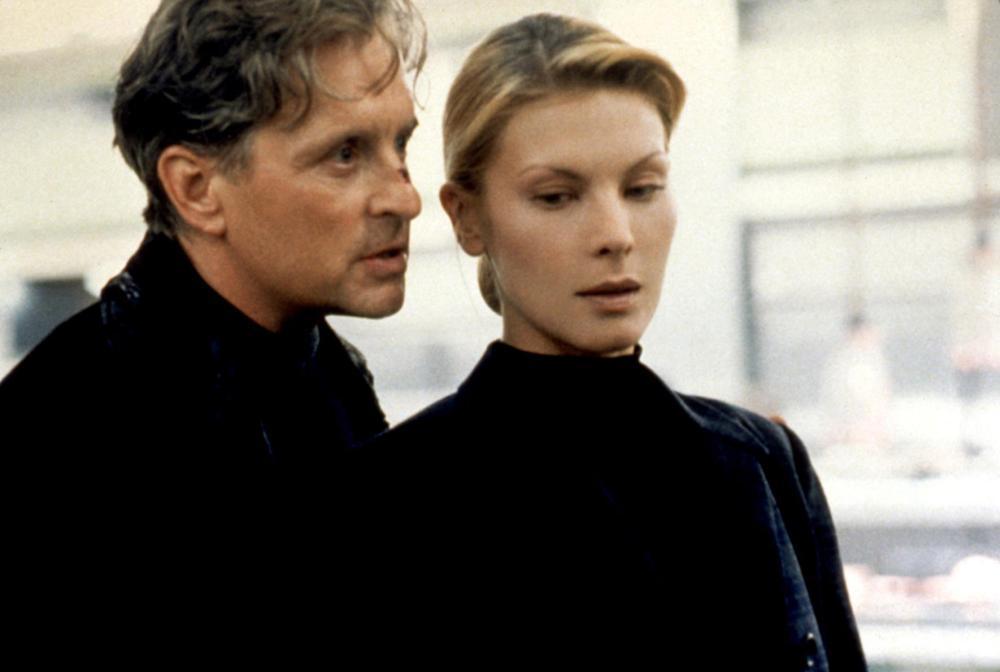
The film operates according to similar guidelines of enlightenment, as much a metaphor for life as the game itself, urging both Nicholas and the audience to understand and respond to its unwritten rules, which are both consistently complicated and always life-changing.
“Did I have a choice?!?” Nicholas asks Conrad during a particularly tense moment in the film. “Did I have a choice?!?” Unfortunately, what Nicholas doesn’t understand at that moment is that he always had an option, maybe more options – as we all do in life. At the film’s conclusion, he stands outside the open door of the car that will take Catherine (Deborah Kara Unger) to the airport. He has just asked her to call him when she returns from her next job — perhaps for dinner — and she has just asked him to join her for coffee at the airport.
A choice has presented itself.
And under similar circumstances, any one of us would find the opportunity to choose between these two options as innocuous, entirely inconsequential. But to Nicholas Van Orton — who has always felt that his life was manipulated by forces out of his control — the option of a choice must seem rather revolutionary.
And a look of quiet understanding falls across Nicholas’ face as he looks across the dark street upon which he stands. He understands now that it’s finally his decision to make – as Jefferson Airplane’s “White Rabbit” sonically creeps into the background with its promise of a choice between two little pills — and another game begins.
The Game is currently streaming on Amazon Prime and other platforms.
***
This piece — written by Justin Howard Query and after some additional editing here — was originally published by another source.
 Front Center Seat [Is Where I Sit]
Leave a comment