by Justin Query
***
As Fede Álvarez’s Alien: Romulus [chest]bursts into theaters, take a look at an alien franchise that sometimes hit closer to home. The Predator series remains an equally formidable mountain of science fiction monster moviemaking.
***
Few imagined in 1987 that when it finally took nothing less than a nuclear explosion to wipe a Predator off the face of the planet that Hollywood would manage to go toe-to-toe with the intergalactic assassin an additional six times over the course of the next 35 years. But long before the original movie’s explosive conclusion, no one could deny that Hollywood audiences adore a comeback story, and fans love few things more than a rematch. In a genre-blending cinematic series spanning more than three decades, the Predator would become the star of film fans’ dreams.
So it was that 20th Century Fox launched a hybrid science fiction action flick in the summer of 1987 that would become an entire franchise, setting a standard for extra-terrestrial warfare that would altogether contradict those family-friendly films that suggested that aliens were visiting Earth in search of friends. Far from it, in fact. If the Predator was seeking anything, it was trophies by which to celebrate its skills, and mankind was the prey.
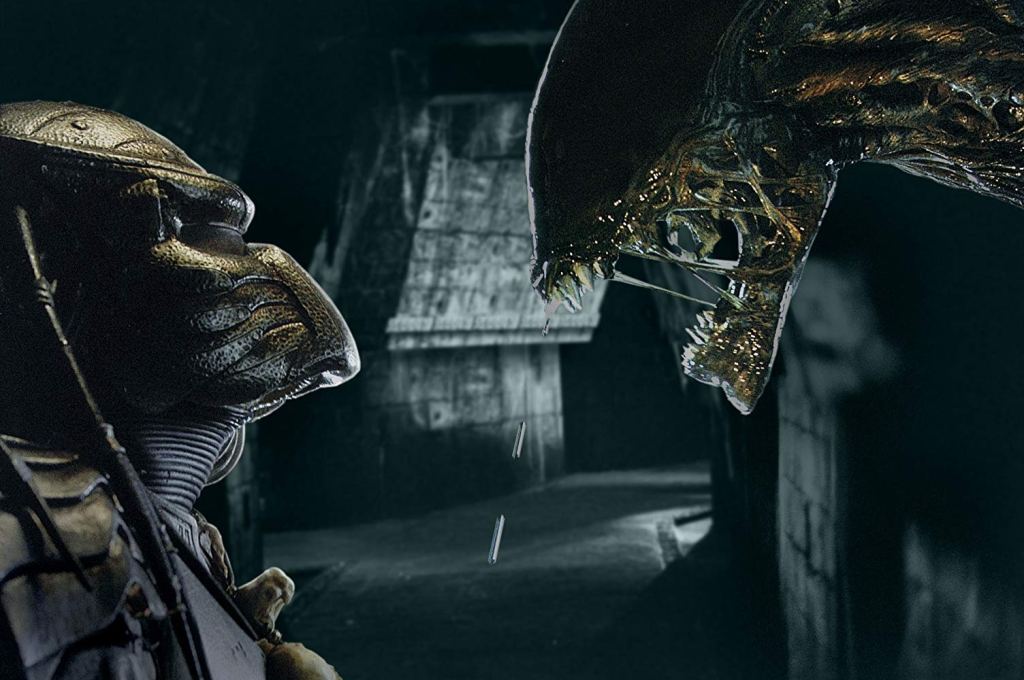
#7 AVP: Alien vs. Predator (2004)
It had been more than a decade since 20th Century Fox’s first Predator sequel, and by 2003, the studio would face off for box office space with other science fiction sequels like Mimic 3, Terminator 3: Rise of the Machines, and two Matrix films released in the same year. Much was running on the prospect of another addition to the Predator franchise, so pitting the Predator against a Xenomorph swarm seemed as novel as pitting Universal Pictures’ Frankenstein’s monster against the Wolfman. Some conversations between Aliens director James Cameron and Alien director Ridley Scott took place on the subject, but Fox opted to build a franchise from the 1989 Dark Horse comic book series starring the two alien killers, producing a movie about an archaeological expedition in Antarctica that would stumble across the two alien factions. From there, the mission would be caught in the middle of a deadly fight between the Predator hunters and Xenomorph brood. If the humans weren’t killed by the Xenomorphs, they’d be killed by the Predators, and were that not high stakes enough, the studio seemed content with killing the production entirely.
The film is perhaps the franchise’s most blatant exercise in fan service, casting Aliens’ star Lance Henriksen as the billionaire industrialist who both finances and intends to lead the expedition but he’s dying pitifully so we’ll forgive him because he hopes to cheat death and leave a notable legacy and certainly the irony here isn’t lost on you. (The franchise wants to cheat death, similarly.) And the character’s name is Charles “Bishop” Weyland. (See what they did there?) Meanwhile, the movie breaks its mythological rules by giving the Xenomorphs a shorter gestation period so that they can grow to adult size faster than ever before, better creating a battleground for the alien warriors within a limited window of screen time. Cutting to the chase early will allow for some significant alien violence theoretically, but it also means that the would-be human heroes will die before their characters are established in any substantive manner for the audience to really care.
But the film also develops an inexplicable backstory for the Predators, creating an unbelievable relationship between the human and Predator races. It’s both schmaltzy and completely out of character, but so is its PG-13 rating, which ultimately neuters the production of the intensity and violence that would prove useful right about now. Lacking the urgency of the first two films, perhaps the intention was to appeal to younger comic book readers who had enjoyed the Dark Horse Comics’ graphic novels, but the creative decision does nothing in service to a franchise that seems to need adult content. So where it sacrifices every opportunity available to dazzle and shock the audience, AVP only manages to alienate its original fanbase. (See what I also did there?)
Then you’ll likely see this one coming too: AVP neatly sets itself up for an unnecessary sequel …
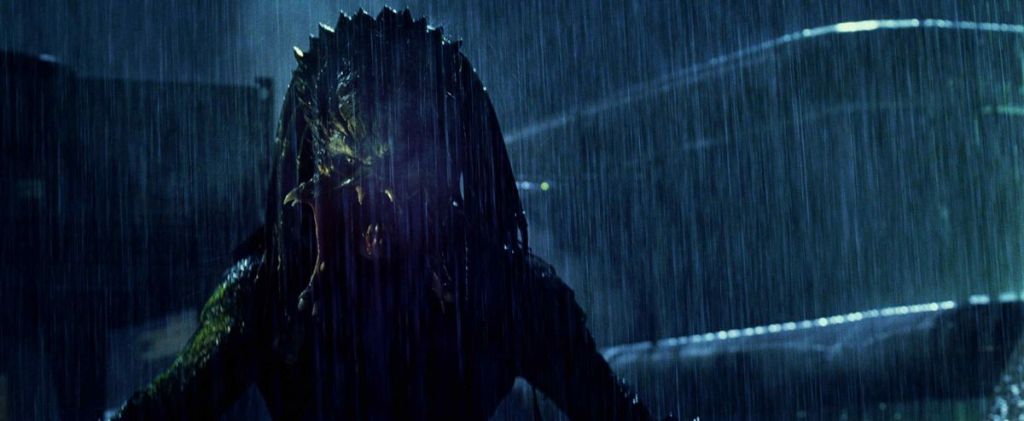
#6 AVP: Aliens vs. Predator: Requiem (2007)
Picking up where the last film left off, AVPR finds the Predators – having defeated the Xenomorph brood – leaving Earth when an alien predator hybrid bursts from the chest of the mortally wounded Scar and makes short work of the remaining Predators. The spacecraft crashlands, the Predalien flees into the lush backdrop outside of Gunnison, CO, and a veteran Predator is dispatched to kill the creature. Human casualties are promised.
Directed by the Strause Brothers from a screenplay by Shane Salerno, the production’s poor reception likely falls on the shoulders of the Strause Brothers. They’d cut their teeth mostly on MTV music videos, and that credit is fully demonstrated over the course of this film. The cinematography makes Fincher’s Se7en look like it was shot in broad dayligh. The movie’s editing cuts away with lightning-quickness from every moment of action when a brilliant point of impact could have saved the misguided scenes. AVPR is a production nightmare, but screenwriter Salerno is also complicit. Among other credits, Salerno holds the distinction of co-writing Armageddon (1998) and entirely screenwriting Savages (2012). One can imagine that Salerno will be credited a few more times as the co-writer of James Cameron’s Avatar saga sequels. But here, the plot is simultaneously overcomplicated and oversimplified – that a movie could do both with such synchronous success is a feat of science fiction itself, ensnaring ancillary characters unnecessarily into its danger for little reason whatsoever and sparing its rather large cast of characters for the majority of the picture. Surviving the first 60 minutes of this movie doesn’t automatically mean that you’ll survive the production entirely. It simply hints at a last-minute death robbed of any pathos.
AVPR may be marginally better than the movie that came before it – but what ultimately contributes to its failure is its betrayal of so much of the nuances of the original films. Predators hunt only the best prey, not suburban game hunters and their helpless children. The Xenomorphs operate best in the shadows, as a concept and idea, until – too late! – the terror is not just suggested but literal. At least AVP had a desolate, cavernous playground in the Antarctic for which the alien killers to wage war. Even the original Predator was set in a treacherous jungle, and the 1990 sequel in dystopian Los Angeles. There is little terrifying or suspenseful about two alien cultures waging war in little more than a national park and some occasional suburban sewer systems. To its credit, AVPR managed to secure an R rating, and one would think that that would have recharged the production and its capabilities. Instead, the film’s violence simply becomes unnecessarily cruel, less like an emotionally conflicting story with meaningful characters and more like a last stand that looks like the filmmakers had something to prove.
If that something had to do with driving the last nail into an outer space coffin and jettisoning it into the cosmos – mission: accomplished.
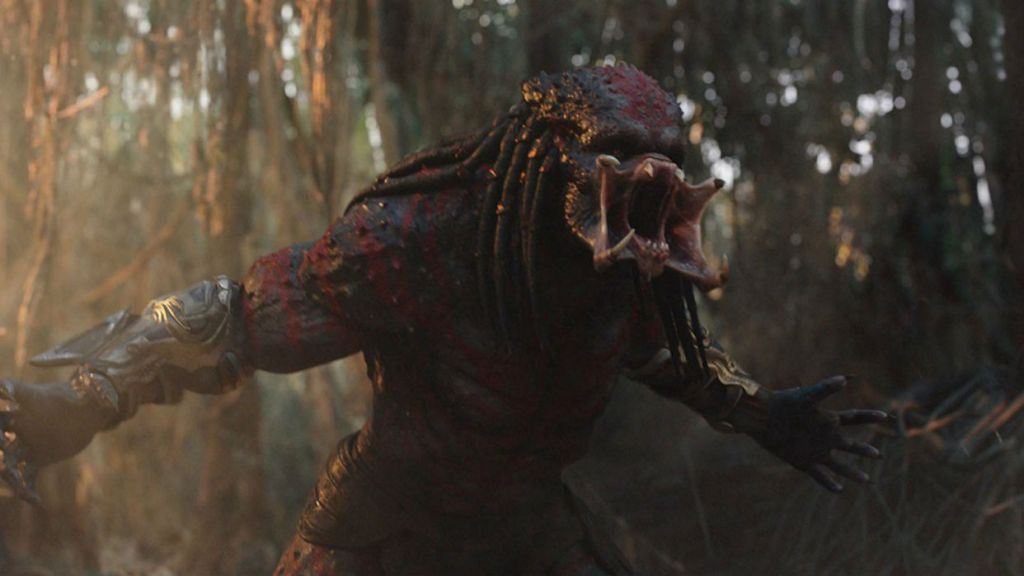
#5 The Predator (2018)
By the time 20th Century Fox produced The Predator some 30 years after the original thrilled audiences on the big screen, fans were already trained to expect the tongue-in-cheek references and predictable story beats that populate this franchise’s sequels. What audiences weren’t prepared for, however, was the film’s ability to embrace and exploit the bombastic, adrenalin-fueled action of the original. The Predator never falls victim to taking itself too seriously, which is precisely what mired the movies that had come before it. So despite any of the inherent issues with this particular production, it remains mostly clear that the players – both behind and in front of the camera – are having fun. That particular point might be one of the singular elements that saves the film, because it then allows the audience to have a little bit of fun as well.
The movie – which never fully posits itself within the mythology of the other installments – begins when a young boy accidentally triggers a worldwide attack of Predators through their own discovered alien technology. The boy’s father – recently discharged from the military because of his own unbelievable story about alien Predators – then leads a reckless team of former soldiers with the help of a headstrong, ambitious scientist, now the planet’s only apparent hope in surviving a global attack. And to be certain, the film stacks a deck with this odd crew of would-be heroes to ensure the most bang for the studio’s buck, mostly in the casting. With a team of performers that includes Boyd Holbrook, Trevante Rhodes, Keegan-Michael Key, Jacob Tremblay, Olivia Munn, Sterling Brown, and others, the movie is buoyed by performances that go well beyond anything the script could have intended. Otherwise, for its part, Black and Dekker’s screenplay is once more – like many of the Predator sequels – more convoluted than it needs to be. Sometime after the 1987 release of the original movie, someone somewhere determined that the simplistic purity of Predator needed an armload or so of steroids – it’s the only reasonable explanation for the parade of sequels that followed it. Someone at Fox determined that if audiences would accept that none of the Predator franchise’s sequels would truly build upon one another like a traditional series of sequels, then audiences would also accept the choreographed chaos that has passed as cinema for the past 30 years, and The Predator follows suit to perfection.
Running through a menu of action flick expectations, then, The Predator leaves few of its stylistic opportunities left unexplored. Its visual spectacle is matched only by the volume turned at all times to 10, and for some fans, that remains the sweet spot, even when they should be growing tired of it by now.
But if they’re still here for the familiarity that’s become a staple of this franchise, they won’t be too shocked at all when the film all but promises that they haven’t seen the last of the Predator, whether it uses its cloaking technology or not …
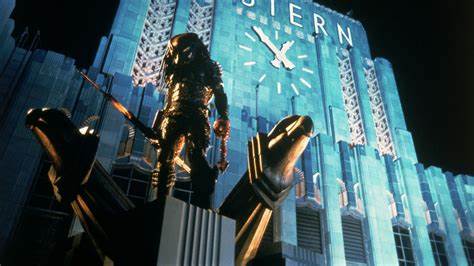
#4 Predator 2 (1990)
The franchise’s 1990 sequel, inspired by real-life West Coast gang violence, unabashedly exploits the nation’s social unrest and casts Los Angeles in a decidedly dystopian manner, thereby intensifying the menace that threatens the country. Man may imagine himself the deadliest living thing in the universe, but society has never faced an opponent like the Predator, who sets its sights on the war-torn streets, and only a handful of L.A.’s Finest might defeat the extra-terrestrial killer now.
Even with its muted Mad Max elements, the film ventures more into science fiction territory than its predecessor in order to raise the stakes on what is a simple hunter-hunted premise. The problem is that if the filmmakers meant to raise the stakes, the bleak L.A. backdrop does little to contribute to what should be the central concern of a Predator hunting relatively helpless, human prey. The film hints at bigger and better and yet never doubles down in doing so. But the movie is otherwise aided – as the original was aided – by an intimidating cast of talent, including Danny Glover, Robert Davi, Bill Paxton, and Adam Baldwin, among others. The cast is also rounded out by a creature as deadly to a production set as a Predator to Earth: the scenery-chewing Gary Busey. As special assignee to the Predator task force Peter Keyes, he says it best when he tells Harrigan, “You know how it is. We all have a job to do.” Unfortunately, the nature of every cast member’s job wasn’t clearly defined through the film’s screenplay before production shooting began. This cast of characters is a bit too complex – unnecessarily so – in composition and constitution, each possessed with such strong, defining motives, to the point of distraction. As human as the characters appear on the page, there simply isn’t enough time throughout the movie to balance the physical conflict with the potentially compelling characters, the latter of which is insinuated but unfortunately abandoned for a lack of time. Ultimately, each character ends up fighting as much for meaningful screen time as fighting against the deadly Predator itself.
For all of the film’s busy nature, overcomplicating the 1987 production’s fundamental simplicity, the movie largely lacks the audience’s emotional involvement in the action. On the heels of a film that saw the audience watch every sympathetic soldier perish at the hands of the Predator, the anonymity of the Predator’s targets here not only robs their deaths of any emotional weight but also eliminates a key component of the creature’s methodology. By nature, the Predator comes to Earth in order to hunt the greatest game. But here, the alien hunter indiscriminately sets its sights on any target that passes within its line of sight, seeking any momentary victory rather than a glorious one. Similarly, the movie fires blindly at possibility rather than targeting a specific course of action, worthy of its assembled talents and potential.
Perhaps, as the Predator says to Harrigan, entirely breaking character before its inevitable demise: “Shit happens.”
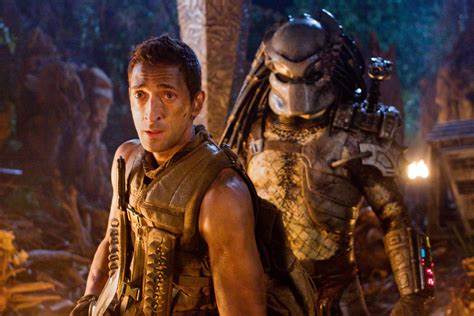
#3 Predators (2010)
By the time 20th Century Fox would look to the stars again, demanding that mankind be hunted by an intergalactic trophy winner, the Predator franchise had been declared dead after its schizophrenic mash-ups with the Xenomorph hordes in the AVP films. Fox had considered a trilogy or more of the head-to-head science fiction action films, intending on saving both star-hopping alien species from extinction, but the box office receipts said otherwise, and the movies certainly didn’t warrant an additional chapter once the critics took aim as well.
It was time for a fresh voice, and Fox found it in Rebel Without a Crew filmmaker Robert Rodriguez, who had already discovered some indie success with his Mexico trilogy, proven that he could appeal to younger audiences with his Spy Kids series, and begun to build his next cinematic universes with an adaptation of Frank Miller’s graphic novel series Sin City and Rodriguez’s own antihero Machete. Having written a screenplay for a Predator project, Rodriguez had hoped to produce a legitimate sequel to the first film – bypassing Predator 2 and entirely ignoring the AVP films – but the screenplay languished at the time due to its intended budget. After the one-two failures of AVP, Fox was ready to take a chance on Rodriguez’s project, even if they would hire a different director to get the picture made.
Predators finds the franchise action relocated to an alien planet game preserve where the world’s deadliest human killers – of the Sierra Leone death squad, the Mexican cartel, the Yakuza, and more – are transplanted in order to be hunted by Predators. Led by a cast of formidable actors, including Adrien Brody, Danny Trejo, Topher Grace, Walter Goggins, Mahershala Ali, and Laurence Fishburne, the movie is a natural step forward from the original and its human heroes. Their stories are a little more fleshed out than those of the 1987 strike force team of the original movie. This particular team keeps the film meaningful in its kill count and unpredictable in some of its plot twists – moreover, the introduction of variously skilled and visually distinct Predators promises no shortage of diversity when it comes to the manner in which the hunter-hunted conflict is further developed for the big screen. Part of the allure of an effective Predator film rests upon the premise that the alien hunter only tracks its most capable prey. To achieve that effect, the human protagonists must also be worthy opponents for the Predator and possess an authenticity that will make their victory or death purposeful to the audience. Predators delivers on all three counts, generating a fresh story more consistent with the original film than the series’ 1990 sequel. Predators establishes with a bit more certainty the potential for a franchise with some cinematic legs – since what makes the franchise so attractive to its fans is the chase itself. Now, even on a count of three … Fox had a deadly head start with this installment of the franchise.

#2 Prey (2022)
This was the installment that no one saw coming. How could someone have anticipated this particular chapter in the franchise? Thirty-five years had passed since the first sci-fi action film in the Predator series astounded audiences, and with each subsequent film, fans were left a little more deflated – despite any redeeming qualities of each film – waiting for a spectacle of a sequel that simply never arrived. Fans of the original Predator film had all but given up hope for the possibility of an inspiring addition to the decades-old franchise, until now. And good things, it would appear, come to those who wait.
Set hundreds of years in the past, Prey watches the Comanche Nation targeted by one of the first Predators to turn the planet Earth into its hunting grounds. But the Predator – like fans of the film franchise – underestimated Naru, a skilled female warrior who will prove the most difficult game yet … for the first time … again. You get the picture.
It is for a reverence to the first film alone that places this particular production in second place on a list of ranked Predator films. This movie is as spectacular as the original film. What is so miraculous here is the film’s ability to stand on its own and not just as another addition to the franchise. Fans needed Alien (1979) before they could appreciate Aliens (1986). Fans needed The Terminator (1984) before they could appreciate Terminator 2 (1991). Prey, on the other hand, needs no other film from the cinematic mythology, no other picture before it. Prey can entirely stand alone as a film, one of the most perfect prequels in the history of moviemaking. As fans tire more and more of franchises that look into their own history in order to discover stories instead of creatively moving forward and taking stories elsewhere, Prey goes where so few films of its kind have gone. By their very nature, prequels lack a considerable amount of peril, but Prey has the distinction not only of being one of the most viscerally effective films of the year but also of being a fantastic bit of feminist filmmaking. Alone in her clan for so long, Naru has been told by others that her sole purpose is to simply survive, to get by. No one imagined that she could ever be capable of thriving in a hunt. Now, she – and her dog – is the star of a film similarly disregarded, if only at first, for a moment.
Over the course of the last three decades, audiences have come to champion the Predator hunters over their human prey. Prey, meanwhile, reminds the viewer that the hunted was always the hero. Here, it’s simply great to be back. For the first time. Again. You get the picture.

#1 Predator (1987)
Directed by John McTiernan, the 1987 science fiction action picture Predator maintains a reputation not only as one of the best science fiction films in genre history but also as one of the best action films in genre history. And contextualizing the production through its major players only casts it in an even more accomplished light:
When Predator was released, McTiernan was only a year away from the summer blockbuster fame that Die Hard would bring him, and yet the director already understood the mechanics of the genre that he would continue to define at Nakatomi Plaza. Meanwhile, the movie is a perfect marriage of not two but three films entirely. Predator possesses the no holds barred action of Commando (1985) and the taught suspense of Alien (1979) but additionally acts like an ensemble film that made Aliens (1986) so spectacular. Predator took aim at so many different cinematic targets and hit them with precise, deadly effect, telling the classic story of a team of commandos charged with a deadly mission in Central America. The team unfortunately discovers that despite all of its skill sets that render the militarized army awaiting them there helpless, the team has everything to fear from an extraterrestrial hunter who methodically turns them into the deadliest game.
And the principles of the Predator were and remain remarkably simple. It’s an interstellar huntsman who only tracks the most challenging prey, nothing more. The prey, meanwhile, is portrayed here by a remarkable cast that includes Carl Weathers, Bill Duke, Jesse Ventura, and – of course – Arnold Schwarzenegger, almost at the peak of his powers. Now add to that team dark horse Richard Chaves and the unflappable Sonny Landham as well as a very young Shane Black as Hawkins, and the team is complete. Behind the scenes, Black would make uncredited contributions to the film’s script here (and hopefully of the perverse sense of humor nature) before taking on the writing and directing responsibilities of The Predator in another 30 years.
And what wonders 30 years can do! Even for its time, the film’s SFX are imposing, and perhaps it’s the originality of the first movie that makes the tri-pointed laser sighting, the infrared vision, and the chameleon stealth technology so innovative. The production not only captivates the audience through its visual mastery but also through its creative implications. Take each of those ingredients and cast it against the film’s heroes and the movie’s audience is faced with a story where every actor is provided a stage upon which to shine and earn the audience’s sympathy and attention. And for a production that all but promises that none of these poor souls are going to leave that jungle alive, that relationship between the characters and the captive audience in attendance remains so incredibly crucial.
It’s precisely what would inspire the studio to turn again and again to a predatory alien killer intent on stealing the show – and a few choice trophies – in the process.
***
The Predator films can be found on various streaming platforms.
***
This piece — written by Justin Howard Query — was originally published by another source.
 Front Center Seat [Is Where I Sit]
Leave a comment