by Justin Query
***
It’s that time of year when families from around the world will visit the House of the Mouse in order to spend a day or many more in a magical world of imagination. Intoxicated by the pixie dust of this place, you won’t be followed here by your monthly mortgage and the nightly news. You won’t be reminded of the challenging responsibilities and duties of the real world.
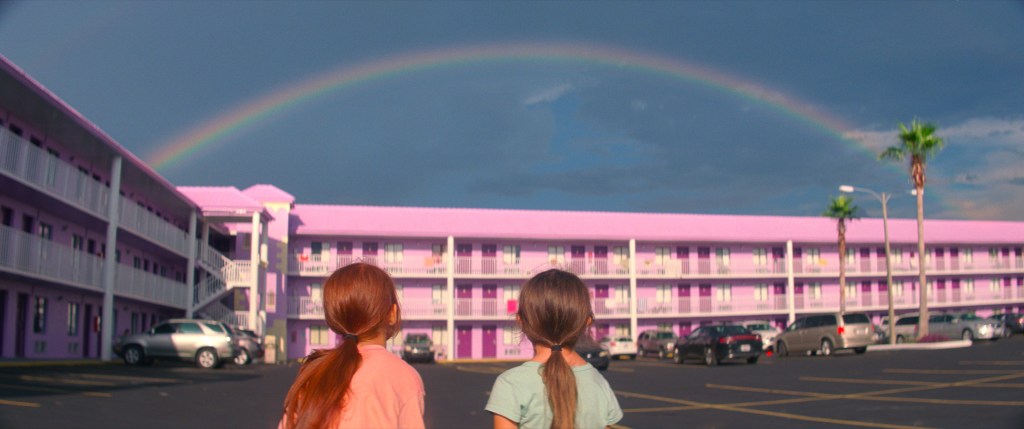
And the real world is The Florida Project, where standing at the center of it is a lesser magical kingdom called Magic Castle Inn & Suites, a cheap Florida motel populated with more long-time residents than tourists, and the film itself tells the disjointed story of its impoverished residents. But the audience will play tourists to this place where the illusion of hope distracts its residents from a challenging life, likely in stark contrast to the comfortable lives of comfort that the viewer knows.
Absent from the film is any sense of a linear plot. But also absent from the film is any sense of pretense, ushering the audience into a multi-colored landscape of vibrant colors that the viewers are simply asked to observe. They won’t be proselytized by director Sean Baker to form an opinion of this place, even if they are sometimes compelled to do so. Over the course of the film, the audience gets to know the young hyperactive protagonists and what constitutes a day for them: grifting patrons at the local ice cream joint for a single cone, going to the motel next door to spit on cars from the second-floor balcony, visiting an abandoned neighborhood of condemned homes. At all times, they are blissfully unaware that they live in poverty, that their families are sometimes a single day from homelessness. And were they aware, it doesn’t appear that they would care. Meanwhile, the adult characters – Halley (Bria Vinaite) and others – are busy with the distractions of their everyday life as well. Halley sends her daughter Moonee to a local restaurant for free waffles and sells wholesale knockoff perfume outside a more trendy nearby hotel. This particular ingredient of the film’s exposition is what allows The Florida Project to be so jarringly realistic. The film’s characters list evermore closely to arrest, to eviction, to a visit by DCFS, that the audience comes to care very much about their plight, painfully so. Like Bobby (Willem Dafoe) the property manager, the audience watches on helplessly, incapable of doing anything to affect the inevitable trajectory of the film.

The Easter egg pastel hues of the Magic Castle replace the anticipated earthy, orange tones that should characterize the world of poverty in which these characters live, who either remain lulled into an acceptance of it or seduced by the property’s facade to the point that they’re incapable of internalizing their situation. Yet this world, a convenient cab ride from the Happiest Place on Earth, seems to serve the same purpose as the Magic Kingdom itself: to provide its visitors a respite from the realities of the world. Hope remains a necessary ingredient for life, no matter how illusory, and the residents can symbolically enjoy the spoils of Walt Disney World even if they lack the currency to go there. The difficulty, though, like the inevitable departure from the Magic Kingdom, is that the illusion of hope is transient as well. Also comforted at times by the laughter and happiness provided by the Magic Castle, the viewer always understands that the spectre of the corporeal world lies in wait around another pastel pink or purple corner.
Unapologetically raw, the film invites the audience into a world where its people seem blissfully unaware of the conditions of their lives.
These conditions are the likes of which some moviegoers will find some discomfort but in so confronting that discomfort are likely to ask themselves the questions the filmmakers magically inspired them to ask. “Is it really possible to forget one’s cares – one’s desperate fate – only through the distractions of multi-colored pastel veneers and brightly-colored wardrobes?”
Unapologetically raw, [The Florida Project] invites the audience into a world where its people seem blissfully unaware of the conditions of their lives.
Ask our young protagonists as they escape the Magic Castle and venture unnoticed down the Magic Kingdom’s Main Street thoroughfare. They can’t afford the admission tickets, yet they cannot afford to not go there either, even for a moment, even if to live with a sort of emotional and psychological amnesia at Walt Disney World.
Ask the guests who make their way down the same pavement, headed for destinations of rapturous delight.
Ask the real-life tourists who momentarily travel to the Happiest Place on Earth in hopes of a similar experience.
Check-out is at 11 a.m.
The Florida Project is currently streaming on Amazon Prime and other platforms.
***
This piece — written by Justin Howard Query — was originally published from another source.
 Front Center Seat [Is Where I Sit]
Leave a comment